
Jack Scanlan
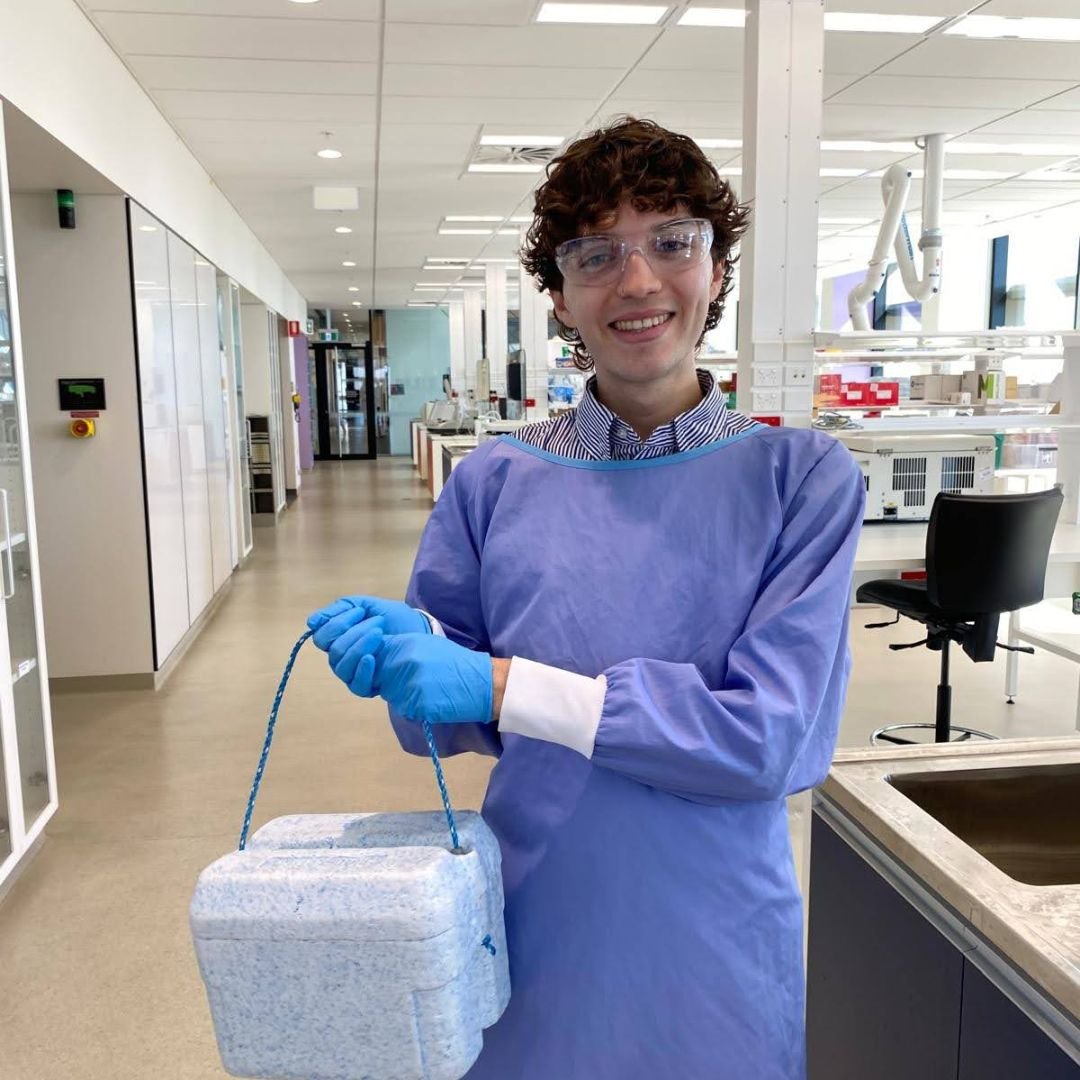
Jack Scanlan
PhD Candidate, Adelaide University
How long have you been involved in ovarian cancer research?
I began researching ovarian cancer upon commencing my PhD in early 2024.
What inspired you to work in this area?
After having been introduced to cancer biology early in my university studies, I became interested in the underlying mechanisms that cause malignancies such as ovarian cancer. The urgent need to improve outcomes for ovarian cancer patients led me to my current work, given its clear aim of improving and extending the lives of patients through scientific discovery. Having a fantastic supervisory team is a wonderful bonus!
About Your Research
In simple terms, what is your current research project about?
We use in-house, state-of-the-art instrumentation at the Mass Spectrometry and Proteomics Facility to identify and quantify thousands of proteins that make up the unique landscape of each patient’s cancer. I correlate this biological information to treatment response data from local clinicians to determine molecular markers of treatment success and failure.
What problem or gap in ovarian cancer care does this research aim to address?
Many patients are already resistant to treatment, yet the absence of a tool to predict who will respond means that treatment is largely based on trial-and-error. By correlating the biological and clinical information from many patients, we aim to develop a tool that can predict one’s response to treatments that are already available. Our recent findings indicate that the unique biology of each patients’ cancer can be used to predict treatment response, paving the way for truly personalised treatment of ovarian cancer.
Why is this research important for women and their families?
Tailoring the prescription of chemotherapeutics to one’s unique cancer biology is a form of ‘personalised medicine’, which will allow us to move away from a one-size-fits-all approach. Through this research, we aim to empower clinicians to formulate an evidence-based treatment plan that will enhance chemotherapy responses while reducing exposure to ineffective treatments that cause severe side-effects. This aligns with our goal of improving outcomes for patients living with ovarian cancer.
The Impact of LLRF Funding
How has funding from the Letitia Linke Research Foundation supported your work / what specifically has LLRF funding enabled (e.g. experiments, staff, data analysis, equipment)? / Would this research have been possible without LLRF support? Please explain.
The generous support of the LLRF accelerates our research on several fronts. Importantly, it has enabled the recruitment of research students like me, who work full-time to further the aim of personalising treatment. It also affords us costly tools and consumables for scientific experiments that provide us with crucial data. Excitingly, the support allowed me to travel to Freiburg in Germany, where the results of similar analyses are already being reported to clinicians for therapeutic decision-making.
Given the challenging landscape of funding for medical research, support from the LLRF is the driving force behind our research.
Progress & Outcomes
What progress or key milestones have been achieved so far?
Just last month, we published the first paper from my PhD in the Journal of Proteome Research (https://doi.org/10.1021/acs.jproteome.5c00771). We show that our method can predict whether ovarian cancers will respond to future treatments using a novel and (easily accessible) type of sample. This precedes our detailed analysis of published literature, which will be released as a systematic review in the coming months.
Are there any early findings or outcomes you can share (in plain language)?.
We have established a workflow that enables the prediction of patients’ chemotherapy responses prior to treatment administration.
Looking Ahead
What are the next steps for this research? / How could this work improve early detection, treatment, or outcomes for ovarian cancer in the future?
We continue to combine our state-of-the-art instrumentation with deep knowledge from our research team and clinical collaborators to make further strides, which will pave the way for the implementation of a personalised treatment approach in the clinic. We have several publications in the pipeline, of which we are excited to share more soon.
Message to Our Supporters
What would you like to say to the LLRF supporters, volunteers, and donors who made this research possible?
I would like to express my sincere gratitude to supporters, donors, and volunteers of the LLRF. We are endlessly grateful for your time, advocacy, and generous financial support that drives our research forward. The lived experiences that you have shared with us continue to inspire us each day, and we remain committed to improving outcomes for all those affected by ovarian cancer.