
Manuela Klingler-Hoffmann
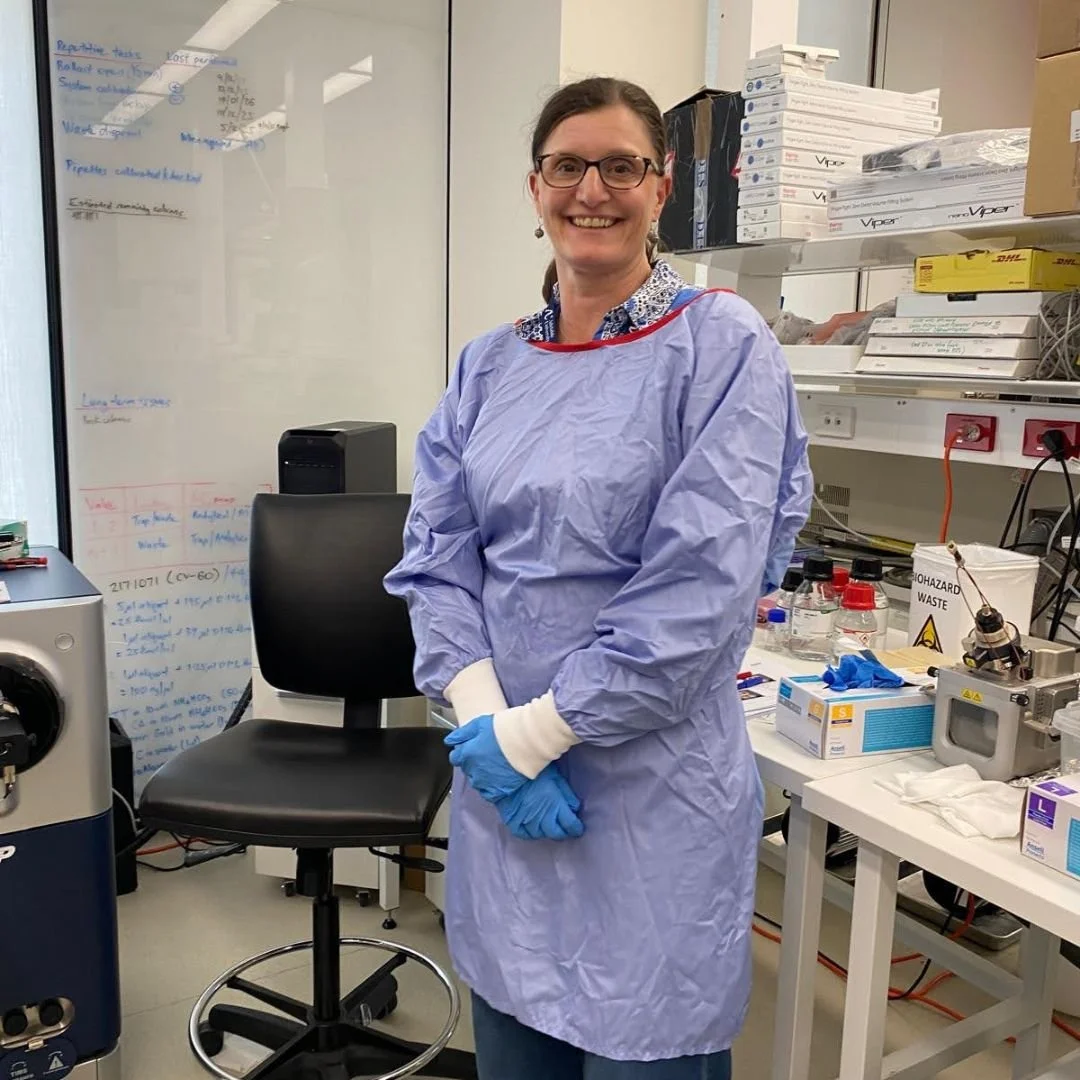
Dr Manuela Klingler-Hoffmann
Senior Research Fellow, Adelaide University
How long have you been involved in ovarian cancer research?
For the last 10 years I have been involved in ovarian cancer research.
What inspired you to work in this area?
The urgent medical need and the passion of the researchers and clinicians involved were my main inspirations. Our project has the potential to revolutionise the treatment for ovarian cancer patients, and I want to make a real difference.
About Your Research
In simple terms, what is your current research project about?
We aim to predict the most suitable treatment for each patient before it begins. To do this, we analyse the molecular signature of tumour cells and develop methods to enhance the details of the analysis.
What problem or gap in ovarian cancer care does this research aim to address?
Currently, most treatments lack a diagnostic test to guide the selection of the best therapy for each individual patient.
Why is this research important for women and their families?
Getting the right therapy to the patients, the first time every time might increase their chances of remission and survival.
The Impact of LLRF Funding
How has funding from the Letitia Linke Research Foundation supported your work?
The LLRF funding has enabled me to assemble as small, dedicated team, working on various aspects of our research question.
What specifically has LLRF funding enabled (e.g. experiments, staff, data analysis, equipment)?
The funding has enabled me to recruit 2 PhD students and 2 Master’s students. It supports their experiments, data analysis, participation in skill-building workshops, and presentations at national and international conferences. Additionally, one PhD student completed an internship at a university hospital in Freiburg, Germany, to learn how they report the molecular characterisation of tumour samples to a multi-disciplinary tumour board for therapy decisions.
Would this research have been possible without LLRF support? Please explain.
The current research program would not be possible without the support of the LLRF. Their generous funding has been crucial in every step of our progress. It has allowed us to recruit talented PhD and Master’s students, provide essential resources for their experiments. Additionally, it has supported their participation in workshops for skill enhancement and enabled them to present their findings at both national and international conferences. This exposure is invaluable for their professional development and for the dissemination of our research findings.
Moreover, the LLRF funding facilitated an important internship at a university hospital in Freiburg, Germany, where one of our PhD students gained insights into how molecular characterisation of tumour samples is reported to a multi-disciplinary tumour board for therapy decisions. This experience is pivotal for integrating advanced methodologies into our own practice.
In summary, the LLRF's support has not only sustained our current initiatives but also enriched the educational and professional experiences of our team, driving our mission forward.
Progress & Outcomes
What progress or key milestones have been achieved so far?
- We were able to show that we can use molecular information of tumour samples to predict if they respond to treatment. This has now been published in the Journal of Proteome Research. https://doi.org/10.1021/acs.jproteome.5c00771
- Our systematic review entitled: “Proteomic studies that predict patients’ responses to high-grade serous ovarian cancer treatments: a systematic review”, received favourable reviews and we have just submitted our revision (15/01/26).
- We are currently working on another research manuscript entitled:” Ascites-Driven Modulation of Cell Phenotypes and Proteomes: Implications for Cancer Progression”. We aim to submit it next month.
Are there any early findings or outcomes you can share (in plain language)?
We have established a sample preparation-data acquisition and analysis pipeline, which can be used to predict patient’s response to treatment based on the analysis of a small tumour sample.
Our work is focused on the analysis of tumour samples to predict patients’ response before treatment starts.
Message to Our Supporters
What would you like to say to the LLRF supporters, volunteers, and donors who made this research possible?
Dear LLRF Supporters, Volunteers, and Donors,
Thank you for everything you do.
Your incredible support, hard work, and generosity have been the driving force behind our research. We honestly couldn't have done it without you. Your time, effort, and donations have made a huge difference. You've not only helped us financially but also inspired us to keep pushing forward.
Thanks for being such an essential part of our journey and believing in our work. Together, we are making a difference!
Best,
Manuela and team